


-118x118.png "images")







Preču piegāde notiek 1-30 dienu laikā no apstiprināšanas brīža.
Vairāk par piegādes noteikumiem skatiet sadaļā Piegādes noteikumi
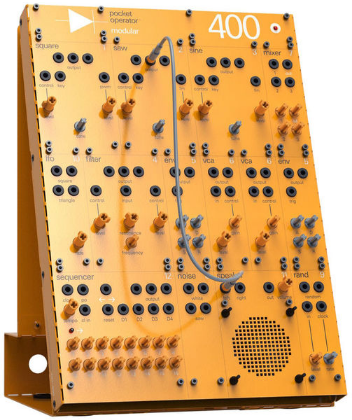
Ritma Procesors Teenage Engineering Pocket Operator Modular 400
€527.00
1000 in stock
Apraksts
before connecting the modules first add the standoffs to the back of the faceplate to make installation easier. start from the bottom and continue up leaving the power distribution until last.to
attach the standoffs, place the screws through the holes from the
outside, and using a pair of needle nose pliers, hold the standoffs
firmly at the back while screwing.now repeat this procedure for all modules leaving only the power distro without standoffs.
note: be careful not to over tighten!
the power distro attaches to
the frame differently than the other modules. first cut the standoffs
from the psu in half using a pair of pliers or wire cutters. then place
the screws through the holes and place the power distro on the back, on
top of the pre-attached protective sticker cover.finally
attach the shorter standoffs to the top of the frame to fasten the
power distro. make sure it is seated flush to the back of the faceplate.
once screwed in place, plug in the cables to the power sockets.
it
is advised to go from right to left and top to bottom. start with mixer
and end with the speaker module, to avoid crossing power cables and too
much tangle.place
the modules on top of the standoffs and ensure the jacks are correctly
aligned with the holes. screw the modules to the standoffs.
ensure the screws on the faceplate are not rotating. be careful not to over tighten.
place the front plate face down. tip: put a soft surface such as towel beneath.
that said you should generally avoid connecting outputs to outputs or inputs to inputs.this
is how sounds and patterns are created in a modular system. the beauty
of modular is that you can pretty much connect anything to anything,
creating all kinds of relationships and interesting sounds, that all
dynamically interact with each other. in modular
synthesis there are two types of signal. audio signals and control
voltages (CV). audio signals are for sounds and CV is for controlling
things. these two different signals will be used to connect the
different modules together.
in a modular
synthesizer it is usually the job of the oscillators to make the sounds
that are processed by the rest of the system. the 400 includes three
oscillator types: a square, a saw and a sine.
lets
hear each of them through the 400’s built-in speaker. first let’s make
sure the volume of the speaker module is turned down. locate the volume
knob on the speaker module and turn it about mid way
pro-tip: you can use audio signals as CV for some very interesting results and some CV modules such as the LFO can run at audio rates.warning: never
connect headphones directly to the outputs of the 400. you can damage
your ears and your headphones if you do this, so be very careful.
now we can change the volume of the speaker by turning the volume knob.
if
you do not hear a sound it may be that your oscillator tuning is too
high or too low. turn the tune knob to alter the pitch of the oscillator
so that it is in the audible range. also turn the pwm level all the way
to the left.to hear the sound
of the oscillator we need to connect it to the speaker. to do this take
a yellow cable and connect it to any of the three jacks labeled output
on the top of the square oscillator. any of these jacks is fine as all
three will output the same signal. take the other end of the cable and
plug it into the jack on the speaker called right.
continuing from the last patch: set up a control voltage to control the pitch of our oscillator.
control voltages
are used to control different parts of the modular system. for example
in the last example we manually altered the pitch of the oscillator but
in this example we will use a control voltage to alter the pitch for
us.
the
lfo is actually just an oscillator that can reach very slow speeds. by
modulating parameters at audio rates we can get all kinds of interesting
effects.
pro-tip: audio
rate is a term used to describe cycling control signals that move so
fast they actually become audible and enter the audible frequency
range.
put on the [filter]. this will pass the audio generated from the
oscillator to the filter. now open the filter all the way by turning the
frequency knob all the way to the right.next: take the filter output and connect to the input on the VCA. turn up both the level and the gain on the vca.
then connect the
output of the vca to the left speaker input. you should hear a constant
note. if you don’t adjust the tuning of the saw oscillator or check that
you opened the filter by moving frequency all the way to the right.note:
the vca or voltage controlled amplifier will control the volume of the
signal. it is possible to do that manually using the level and gain
knobs. this patch uses the envelope for this.
connect
either clock out or po out of the sequencer to the trigger input of the
envelope. the clock pulses will trigger the envelope every step of the
sequence, where po out triggers every other step. adjust the ADSR
(attack, decay, sustain and release) on the envelope to get different
changes in the volume. try setting attack all the way to the left.now connect the
envelope output to the control input on the VCA. this will let the
envelope signal control the volume of the sound. the envelope has to be
triggered to know when a note is sounded. we can do this from the
sequencer which we will also use to set the notes of the sequence.
it
is generally advised that you avoid connecting inputs to inputs or
outputs to outputs. doing so can put unnecessary strain on the system
and over time may eventually lead to damage.
do
not plug outputs of the 400 directly into equipment that is not
designed to handle the larger voltage. for example, pocket operators,
effects pedals etc. please consult the manufacturer of the product in
question if you are not sure. do not connect headphones
directly to the 400. you can damage your headphones or much worse, your
ears. always protect your hearing.
Papildus informācija
| Weight | 0.00000000 kg |
|---|
Piegāde


